

This report addresses an incident of rainwater penetration affecting a residential building located in Earl’s Court, London. The issue was identified following visible internal dampness and external deterioration to the brickwork. Upon inspection, the primary cause of the water ingress was determined to be a broken and overflowing rainwater gutter, which had failed to discharge water correctly during periods of rainfall.
The building is of traditional masonry construction, typical of properties within the Earl’s Court area, with solid brick external walls and a pitched roof draining into perimeter guttering. The guttering system is designed to collect rainwater from the roof and channel it safely away via downpipes. However, in this case, the gutter had become damaged, resulting in persistent overflow during rainfall events.
Cause of Defect
The defective gutter was found to be cracked and misaligned, preventing effective drainage. During periods of moderate to heavy rainfall, water overflowed from the gutter rather than being directed into the downpipe. This overflow allowed rainwater to cascade down the external wall face in an uncontrolled manner. Over time, this repeated exposure led to saturation of the external brickwork and mortar joints. Brickwork is inherently porous, particularly in older buildings, and prolonged saturation allows moisture to migrate through the masonry by capillary action. The defective gutter therefore created conditions conducive to water penetration through the external wall, resulting in damp ingress to the internal fabric of the building.
External Damage Observed
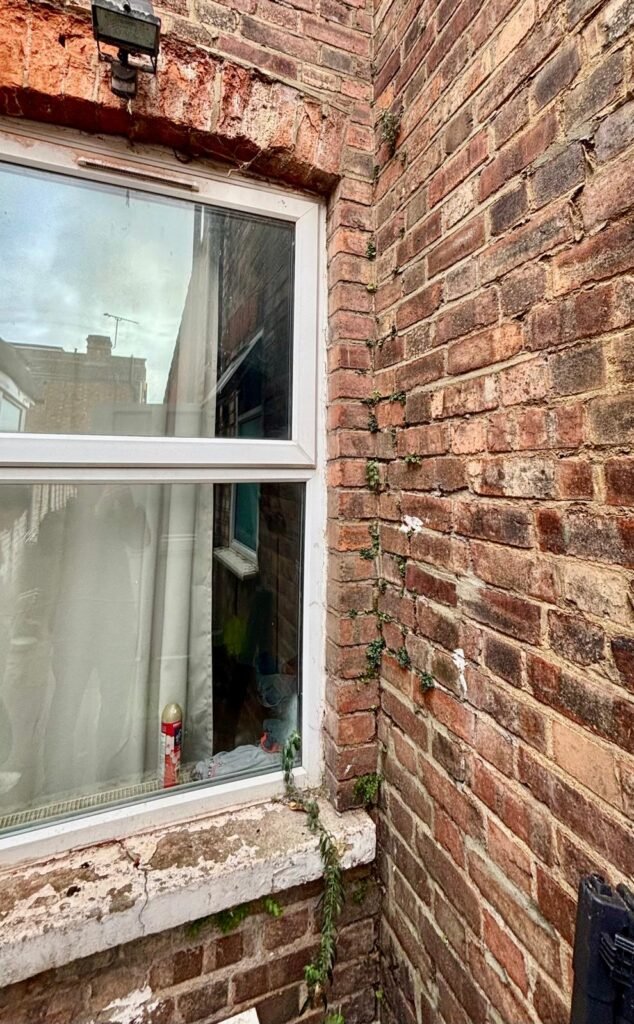
Externally, staining to the brickwork was evident below the location of the damaged gutter, indicating repeated water runoff. Localised deterioration of mortar joints was observed, likely caused by prolonged moisture exposure and potential freeze-thaw action. In some areas, the brick faces showed signs of surface degradation, consistent with long-term saturation. Efflorescence was also noted in isolated sections, further confirming moisture movement through the masonry. These defects, while initially cosmetic, pose a longer-term risk to the integrity of the wall if left unaddressed, as ongoing moisture exposure can accelerate masonry decay.
Internal Damage Observed
Internally, damp damage was evident on the wall corresponding with the external defect. Signs included discolouration to wall finishes, damp staining, and blistering or peeling of paint. Elevated moisture levels within the wall fabric were consistent with rainwater penetration rather than condensation, given the localised nature of the damage and its alignment with the external gutter failure. In some areas, plaster had begun to deteriorate, losing adhesion to the underlying masonry. If allowed to persist, such damp conditions may also encourage mould growth, adversely affecting indoor air quality and occupant health.
Contributing Factors
The damage appears to have developed progressively over time rather than as a result of a single rainfall event. A lack of routine maintenance to the rainwater goods likely contributed to the failure going unnoticed. Blockages from debris, combined with the damaged gutter section, may have exacerbated overflow during rainfall. Given the exposed location of Earl’s Court and the frequency of rainfall in London, effective rainwater management is essential to prevent such defects.
Remedial Recommendations
Immediate repair or replacement of the damaged gutter section is required to prevent further water ingress. The gutter should be securely fixed, correctly aligned, and tested to ensure efficient drainage into the downpipe. All adjacent guttering should also be inspected for defects or blockages. Once the rainwater goods have been repaired, the affected external brickwork should be allowed to dry naturally. Repointing of damaged mortar joints may be required using an appropriate breathable mortar to match the existing construction. Any severely damaged bricks should be replaced as necessary. Internally, damp-affected plaster and finishes should be removed once the source of moisture has been resolved and the wall has sufficiently dried. Replastering should be undertaken using suitable materials, followed by redecoration with breathable finishes to reduce the risk of future moisture entrapment.
Conclusion
The rainwater penetration to the building in Earl’s Court was caused by a broken and overflowing gutter, resulting in prolonged saturation of the external brickwork and subsequent damp ingress internally. The damage observed is consistent with long-term rainwater exposure rather than a sudden failure. Prompt repair of the rainwater goods and associated remedial works are essential to prevent further deterioration and to restore the building fabric to a satisfactory condition. Photographic evidence provided separately supports the findings and conclusions of this report.
